| Leica Short Movie by Wim Wenders ★ | youtube.com |

© Leica
90-second short by Wim Wenders, starring Wim Wenders and Wim Wenders’ Leica M8.
| Leica Short Movie by Wim Wenders ★ | youtube.com |
© Leica
90-second short by Wim Wenders, starring Wim Wenders and Wim Wenders’ Leica M8.
| Apple & Photography ★ | thenextweb.com |
Over at The Next Web, Nancy Messieh wrote a piece titled ‘Did Apple redefine photography with the iPhone?’. In it, she raised the question and laid out her arguments to support her hypothesis on Apple’s increasing investment in iPhone’s photographic capability, and the disruptive effect it had on the way we deal with photography:
Some might say that the iPhone has certainly reinvented photography but not for the better. With the rise of apps like Instagram, Hipstamatic, PicPlz and countless others, filtered smartphone photography has dominated social networks much in the same way that the iPhone has dominated Flickr.
The problem with apps like Instagram is that some people take photographs of things they normally wouldn’t, slap a filter on it, and think it’s fit for sharing. Whether this is Instagram’s fault or not really comes down to opinion. Would those people be just as likely to share photos taken in front of the bathroom mirror, photos of their breakfast, pets, and more?
[…]
Instagram’s power is in the fact that it creates a communal experience. Part of the allure is the filters, which are possibly among the very best available in any smartphone app, but what good are shared photos if no one is looking at them. Apps like Instagram create an opportunity to share images, but when we take a closer, more professional look at them, do they still meet the grade?
The thing that makes the iPhone a compelling tool for photography is its straightforwardness. You shoot, you tinker, you share, and people can see it immediately. Technicalities disappear behind the final image’s effects & filters; the moment becomes the indisputable story without second guessing the shutter speed and the aperture value.
Camera makers have long fought for technical edge and spent ridiculous amount of money marketing their products that way. It turned the table around and made the cameras, lenses the star of the show with the photographer as the sidekick. Did someone know what kind of canvas, brush and paint Da Vinci used for the Mona Lisa? Does it matter?
What matters to me now is that whatever the reason iPhones are the most popular digital camera in Flickr, it puts a smile to its users and the friends & family surrounds him/her. It made photography fun again.
| Decorating the West Point Style ★ | goruck.com |

© Jason McCarthy
Lovely persona behind the military uniform.
| Kubrick’s Eyes ★ | designintell.vandm.com |
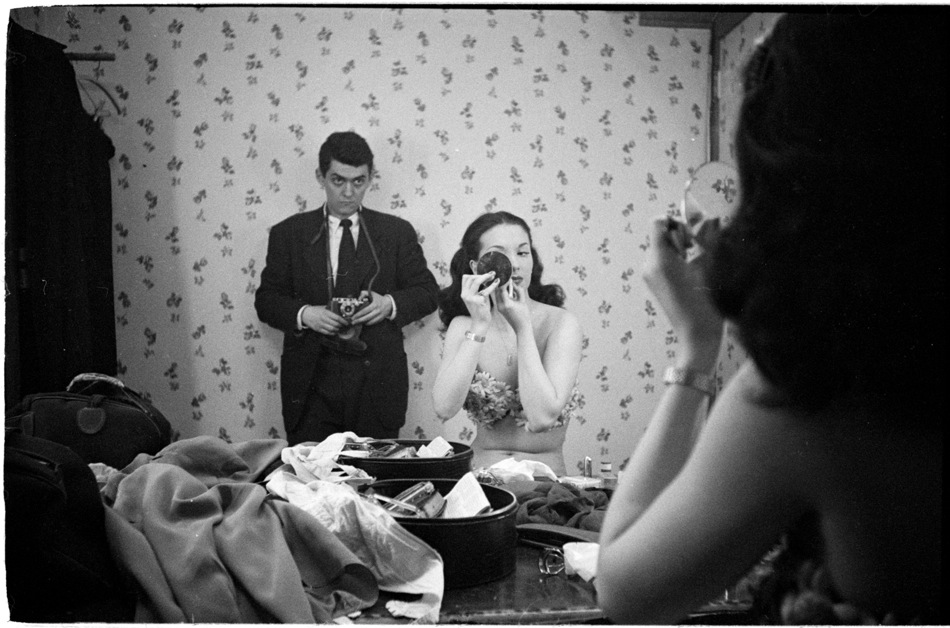
© 1949 Stanley Kubrick/LIFE
Take a closer look at those pair of eyes. He sees beyond his, or the subject’s points of view, somehow managed to raise the viewing field to that of the spectator’s and infuse a little touch of his magic. He was a complex soul fighting his freedom off it, encapsulating the complex nature of human tendencies into a frames after frames of golden moments.
From the curators:
Images in this collection show the drama—both human and artistic—that infuse Kubrick’s work. Included are: the photograph used on the cover of the Kubrick book, Drama & Shadows, of a young woman making her way down a steep set of stairs while carrying a pile of books precariously tilting books; showgirl Rosemary Williams intently applying makeup as the equally intent young Kubrick photographs her. His subjects are as varied as the city he worked in: he catches Broadway actress Betsy Von Furstenberg studying her lines; prizefighter Walter Cartier in the corner between rounds; Dwight Eisenhower, also between rounds—after World War II, before he became President of the United States—when he was Columbia University’s president, and performers from Ringling Bros. and Barnum & Bailey Circus.
Also by Kubrick: Chicago, 1949. (via DF)
The number of times the word ‘Fine’ appear at the product’s homepage?
None.
They should have done this from the beginning with the X100 (and the X10).
I’ve said it before, I’ll say it again: Camera sling is the way to go to carry your camera. If it works for the army, it’ll work for everyone.
I did my share of research before I made my purchase. By research, I mean about closely watching half a dozen YouTube video review and reading good, bad, stupid, but often, honest comments from some discussion forums and weblog.
The Black Rapid actually came to my attention when I was researching for a Luma Loop alternative; I was trying to observe why would they prefer a non-Luma product, and Black Rapid, by their share of noise have gained some viral attention on YouTube and photo weblogs, even users I have never met, seen, or heard before, but they seem to have gained traction too.
The Luma, on the other hand, came to me rather quietly. Basically I discovered I would need a sling strap as a redundant backup to my then-new Capture Camera Clip, and I remembered an old post I read about the Loop, and thus began my ‘research’.
My conclusion was clear. I need something simply invisible, so against their recommendation, I actually preferred the LoopIt — the non-padded, smaller version of the Loop — than it’s bigger brother, the Loop v.2. I didn’t even bother to consider anything else knowing how parallel my believe and Luma’s approach are. Everything else don’t matter to me. (At one point, a Black Rapid evangelist even offered to give some of their straps for free. I discreetly declined.)
I made the purchase last March, and I’ve been happily using it along with my also then-new, Goruck GR1, Capture Clip, Canon EOS 7D, even my big-shot Canon lens, the old EF 80-200 ƒ/2.8L.
Until Black Rapid was awarded a patent related to this product, and somehow Luma was cornered to discontinue the Loops:
In short, the idea of a sliding camera sling isn’t an amazing new invention. It’s just a really good idea that’s been around for a while and which has been iteratively developed. Neither we nor our lawyers believed that the USPTO would grant a patent for the claims related to this concept. It was a surprise, then, when our competitor was granted a patent covering the concept on November 1st, 2011. To say that we’re disappointed that the USPTO couldn’t find the prior art around the idea is an understatement.
I’m saddened for this to happen to the Luma Labs for they are making such a great product, and for Black Rapid to seize a common product and use it to kill competition. Free market means we as consumers are free to choose, and the reward goes to those who makes better products. And today, more and more excellent products come from smaller, private companies mainly with passion as their mantra. This patent mumbo-jumbo kills the magic and such freedom to choose, and it is simply unfair.
I am excited, however, by Luma’s rigor spirit to fight it with ‘reinvention’ instead of a meaningless, time-wasting, soul-killing battle in the courtroom, and there’s nothing better to progress than the desire to move on with the most positive way from a less positive situation. There’s nothing to better power progress than that very spirit.
To photograph is to hold one’s breath, when all faculties converge to capture fleeting reality. It’s at that precise moment that mastering an image becomes a great physical and intellectual joy.
| Compromise Is Not Loosing ★ | luminous-landscape.com |
Michael Reichmann threw a first-look on the Fujifilm X10:
… the laws of physics get in the way of our fantasies. The major camera makers are doing a fine job of pushing the boundaries of what’s possible, but there are still fundamental limits. Ultimate low noise requires large sensors with large pixels. Large sensors require large lenses. Fast lenses for large sensors are inherently big and heavy.
And yet:
The camera has a 12 Megapixel 2/3 inch EXR-CMOS sensor. This means that the sensor is 8.8 X 6.6mm (typo corrected) in size, about double the surface area of most pocket digicams. The lens has a 7.1 to 28.4mm focal range, which translates to 28 – 112mm in full frame 35mm terms. This means a 4X multiplication factor compared to standard FF 35mm. By comparison a Micro Four Thirds camera has a 2X factor sensor, while a typical digicam sensor might have a factor of 5X to 7X.
Another thing — the zoom ring:
One of the X-10’s singular features, which will appeal to many photographers, is that the lens zooms via a twist ring on the lens barrel. This ring is also the camera’s On / Off switch. To operate, simply turn the ring, which switches the camera on with the lens at first at its widest focal length. Then, if you wish, continue to rotate the ring until you have the framing that you want. This is a very appealing feature compared to the stepped electric zoom function of most other cameras in this class.
The OFF detent is nicely firm and the zoom feel is very linear, with a smooth helical gear moving the lens from 28mm to 112mm in less than 45 degrees.
It didn’t take more than a couple of days of shooting to determine that having a manual zoom ring on the lens, combined with the On / Off switch, is one of the cleverest new camera designs in ages. Kudos to Fuji for coming up with something that is not only unique but really photographer friendly and useful.
Design turns problems into solutions, obstacle into advantage, but most importantly breeding imagination through limitation — in Fuji’s case: physical size vs. optical excellence. As I have said repeatedly on the excellence of Fuji’s new X-series team, they seem to have nurtured some great design virtues and approach in their X products, and the results are paying off.
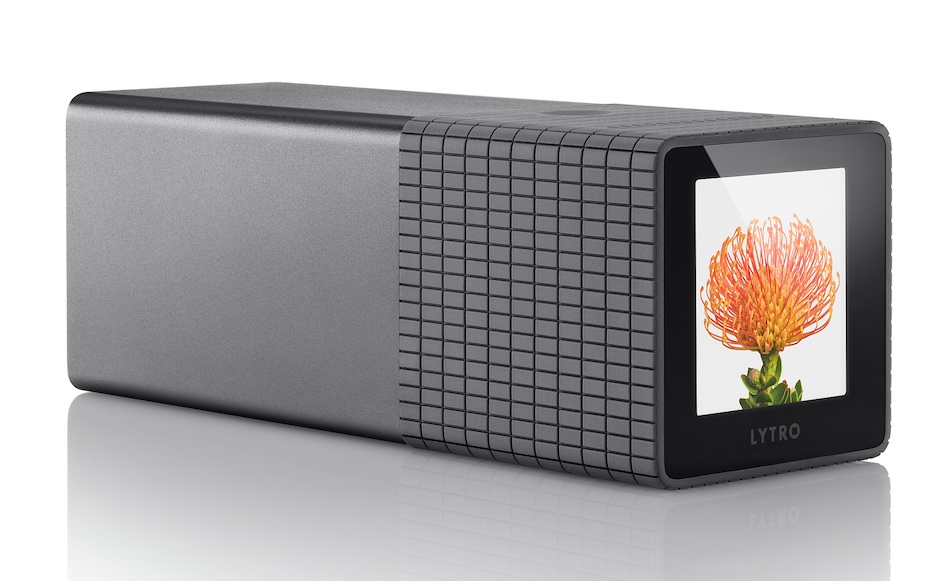
© Lytro
Since it’s made its web debut late last year, Lytro has been making rounds on the web as the next generation game-changing camera. Earlier this week, they finally introduced their first line of consumer camera, also called Lytro, and gave a demo at the AsiaD conference.
Lytro reads not just the light, but also the three-dimensional information and records it as raw data on their 8 megaray[1. Lytro’s version of megapixel] sensor as a light field construct.
After you download the data via their proprietary software[2. Mac only now, Windows version in the work], you can then explore the depth-of-field of the image, the same way you would focus a scene with your regular camera, only this one happens after you take the shots.
Light field photography isn’t new. Engineers and scientists have played with this in labs for years, perhaps in the last one or two decade, but Lytro is the first one to bring this to the consumer market.
Though it is a scientific breakthrough, I don’t see Lytro as a disruptive consumer product.
Digital photography takes the niché origin of this art form to an unprecedented mass. it takes the image from print and galleries to the now-ubiquitous screens. You take a picture, share it and everyone can see it without installing any new plugins, software or viewer. It is instant, simple and easy.
Lytro, on the other hand is an entirely new dimension. It is more complex and the product it presents has much more information that requires a level of complexion that distort photography as we know it.
At the time of this writing, lytro-captured images require a Mac with the Lytro desktop software installed to be processed and viewed. And there’s no _final_ state of the image as each and every one of them is refocus-able. Such state of indefiniteness serves a different purpose and a different kind of audience.
On the other hand, the [bold new design](http://allthingsd.com/20111019/lytro-demo-at-asiad-video/) of this Lytro camera raises the question of practicality and usability.
Let’s pretend that you have read the manual, and someone at the shop has given you a quick lesson to use the camera. How usable is the touch-based operation on the field? Is it operable with a sweaty palm? Or with a glove on? Will someone be able to use it when you ask a stranger to take your photo with it?
This kind of over-simplification sort of beats the purpose of a camera. The company seems too eager to cash-in the way Apple does with the iPhone and the iPad. The consumer market is very attractive, but they are also a very volatile, unpredictable as an entry point for groundbreaking scientific inventions. But what if this whole Lytro-thing is more suitable for the professionals?
Think archeology, science, medical, filmmaking, investigative research, or any field that requires a time-proof recording of informations. Imagine lytro-endoscopy, where a doctor takes one image and study every part of our ingestion organ one click at a time without having the endoscope dive to every part of it. Imagine where an archaeologist takes one picture and study all surface of their research without having him/her take multiple images of a single scene. Imagine police cameras where they don’t need image-enhancing software to see the license plate of a car of a crime scene snapshot? Imagine shooting a movie where we no longer need to follow focus but have it done in post-production.
Nonetheless, it’s an exciting new technology. Lytro opens up a new world of photography that would open up people’s imagination. And imagination is a powerful force that bring us the impossible.
It is just the beginning.
| The Last BSG Supper ★ | en.battlestarwiki.org |

© SyFy
It’s interesting that everyone thinks there is something hidden in that Last Supper photo, like if you look hard enough, you can find a hidden message in it. To be honest, I think we would have had to be in on it to create a hidden message, and we were all just there having a photo shoot.
Da Vinci was a genius. (via @Shanghaidaddy)