| Emancipated ★ | gbobg.com |
© Unknown
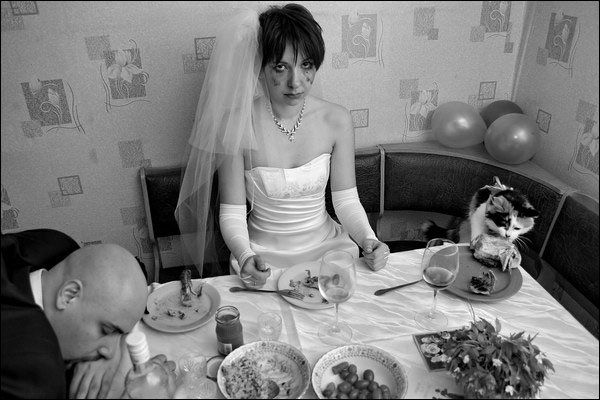
Gives a new meaning to “I do”. (via holykaw)
| Emancipated ★ | gbobg.com |
© Unknown
Gives a new meaning to “I do”. (via holykaw)
| Besieged ★ | jmcolberg.com |
Photographically, the intention is to create a large-scale PORTRAIT INSTALLATION of as many of the women, men and children raped over a 4-day period in Walikale of the Democratic Republic of Congo, as possible; over 300 people were reported to have been raped within that time frame, in late July, early August, 2010. The portraits will be a representation of the humanity of these people juxtaposed with the unacceptable crime committed against them in an effort to gain political leverage.
| ShiftIt: A window management app for OS X ★ | github.com |
Windowed interface is a pain in the ass.
It’s not because it doesn’t do anything, but because it does everything and it does it in a freestyle, manual way that gives the headache, it even creates an entire category of window resizing management app and we have a slew of them — mostly paid with prices between $1.99 to $14 — at the time of this writing.
But I also found this app.
It’s a fork of an original abandonware, and the latest available build is dated Nov 2010 (version 1.5).
It’s a low-memory usage, menubar-based background app (removable icon), supports 8 different window mode including center & fullscreen maximizing for every active OS X window. On version 1.5, though, the app is still yet to support restoring windows to their original size[1. The maintainer seemed to have implemented this feature and will make it available on the next release.] like some of its paid counterpart, but at $0, with enough window resizing scenario possible (I’m home with the side-by-side left-right scheme), keyboard shortcuts & removable menubar icon, and a reasonable roadmap, I’m not even gonna complain.
And I think the Fifth Gear-style icon was cute.
Speaking of finding food & earning a living, photographers today are becoming more creative in getting more money-generating work, documentarians are doing commercial work on the side, and many commercial shooters are doing documentary when time allows it.
Photojournalists and documentarians often depend on scientific or social grants beside their fixed or assignment-based income, it’s pretty much like a pitching contest with commercial clients but you compete with a slightly different agenda, in commercial terms, the client’s formula is to award the best portfolio with the best price, while grants are being rewarded by your academic or scientific credentials, relevance and sometimes, inside connection. Both are highly rewarding, more to the latter, creatively perhaps, but also very competitive.
But now more and more grants also depend on corporate sponsorship which means a shift in their priorities, no longer a project can be purely academical or scientific, but also commercial priorities are in play.
A good photographer gets a grant and win projects, but a smart one not only win contracts or secure a series of grants, but also has the capacity to improvize, evolve and maneuver themselves in the process. Like James Morgan & his Bajau Laut project:
Initially Morgan’s intent was to approach the project as an ethnographic study. In 2009, he applied for the Royal Photographic Society’s Postgraduate Bursary award, and won it. It provided him with about $5,500. “I had all this money and support, but I had no idea how I would find the Bajau Laut people,” he says.
The Bajau people are that of the Borneo region, migrated from the northern part of the east-west pacific region to the northern tip of the Indonesian Archipelago, mainly around the coastal lines of the Kalimantan and the Sulawesi islands, but also spreads to the Southeastern Sumatera, the Riau islands as well as western Papua. Though they may come from different tribes with different names, it is believe that they are part of the Bajau tribes from the southern Phillippines and are some of the world’s last remainding sea tribes.
Like us islanders, they work, live and grow in their own habitat — the sea, so they adapt and evolve:
“Part of my interest in the project,” Morgan explains, “was the free-diving aspect. When marine mammals hold their breath for a period of time, their heart rates and metabolism slow. That happens to humans, too. I thought that connection [between humans and their environment] was interesting conceptually.” He also wanted to free-dive to connect with his subjects, and to avoid the hassle and expense of taking SCUBA gear.
It’s not difficult to teach ourselves something, having the heart to do it is the hard part, I mean Da Vinci taught himself to write with both of his hands, and simultaneously in both left-to-right and right-to-left directions in multiple languages, so how hard can things be, right?
So studied Bahasa Indonesia Morgan did and practiced free-diving[1. I taught myself to free-dive when I was on a vacation in Amed, Bali about 2.5 years ago, and it’s a great skill to have, but I mostly did it to piss-off the PADI guys and their ridiculous fees & regulations.] in the process and sets off to Sulawesi, not to actually initiate his project per se, but for an unrelated paid assignment:
Morgan spent about six months studying the language and practicing free-diving. Then, with an assignment from The Guardian to shoot an unrelated story, Morgan set off for Indonesia with writer Johnny Langenheim (who is also fluent in the language.) Once they finished work for The Guardian, they set out for a Bajau Laut stilt settlement on Sulawesi, Indonesia.
And that my friend is the heart of the matter.
Photography is 90% about getting the job and 10% about executing it — these milage may vary — but without a sustainable work and income, a photographer is just a man with the camera.
Photographers are also keen observers, they are also survivors, survivors who are keen to observation evolve, and those who evolve adapt, they improvize to make the best out of the worst situation. It’s not only in the field, but also behiind the desk, in dealing with clients. The truth is there is not enough perfect assignments to satisfy a shooter’s soul & pocket, we just need to find the threads and tie the knots to make a stronger rope.
On the other hand there are issues about ethics:
It isn’t unusual for photojournalists to seek alternative sources of funding for their projects, now that publishers won’t (or can’t) support them. But turning to subjects for financial support for a documentary project raises obvious ethical questions. […]
There’s always two sides of every story.
The writer of the story raised some good points, but the ethical concern is not about James and his publisher, but rather James and his client. It’s not impossible to shoot two projects in one place, trained well, many photographer can come up as winners, but many also fails to maintain a clean and transparent record doing so, the key is not to raise conflict but to avoid them — find the threads and tie the knots to make a stronger rope so you can tow another boat while you row one.
The real question is why most publishers fail to commit to a story, mental support is trivial compared to the financial undertaking and we won’t be talking about this if there’s enough money on the table, but there isn’t.
To say that James is a real winner is an overstatement, but he showed us what can be done to weather the storm and to come out as a winner. And that’s just a story amongst the thousands of winners out there.
Turned out nomadic is our nature, after all, we no longer skip places much, but we do skip from one priority to another, one story to the next, and that’s how we grow.
Further viewing:
The Bajau Laut by James Morgan
| To All the Crazies… ★ | folio.jorgeq.com |
Jorge Quinteros gets it:
Sounds crazy but when I’m out photographing, I literally pretend I’m on assignment for a prestigious magazine who I have to deliver quality work not just because they believe I can execute but because they’ve already given me an advance to do it.
When we go out and take photos on the street, at the park or a place where people play, we are touching the very fabric of real life — no make-ups, no acts, no pretending, you are breathing and living the moment, … it’s awesome. This atmosphere is rare in a photo set, even more so in a commercial photoshoot where we are running on someone’s clock & money, shooting something that they want to see.
For that reason, I pick my assignments carefully; either I do it with all my heart, or nothing at all, I hate turning down assignments, especially ones that feeds my stomach, but the agony of doing something pretentiously is killing my soul, I’d rather go hungry rather than spiritually numb.
There’s no other way to do it, go all the way or don’t, you can always find food, but you can never turn back time.
| Photographers are Pertinacious ★ | graphpaperpress.com |
Thad Allender[1. Original designer of the theme this site uses], a reasonable pertinacious shacker[2. Shooter/hacker, duh.] who happens to know some shit about WordPress, has some advice most of you would ignore so I’m just going to point one, that should have been on top of the list:
10. Don’t use Flash
Learn by doing, listen by observing, but be great by implementing, at least for once. I promise you won’t regret it.
| Antarctica in 1915 ★ | howtobearetronaut.com |
Courtesy of State Library of New South Wales
State Library of New South Wales:
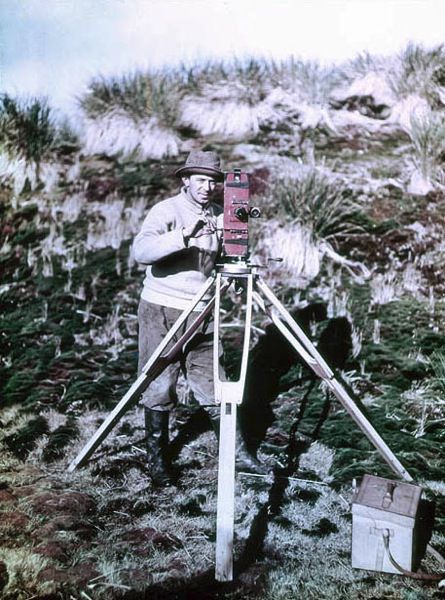
These are Frank Hurley’s famous early colour photographs of Sir Ernest Shackleton’s ill-fated ‘Endurance’ voyage, as part of the British Imperial Trans-Antarctic Expedition, 1914-1917. Hurley was the official photographer on the expedition.
This kind of ‘early color’ look gives me a sense of timelessness, I like looking at these pictures.
(via Kottke)
Technology alone is not enough. It’s technology, married with liberal arts, married with the humanities, that yields us the result that makes our hearts sing.
| Annie’s Dream ★ | telegraph.co.uk |
© Annie Leibovitz/Disney
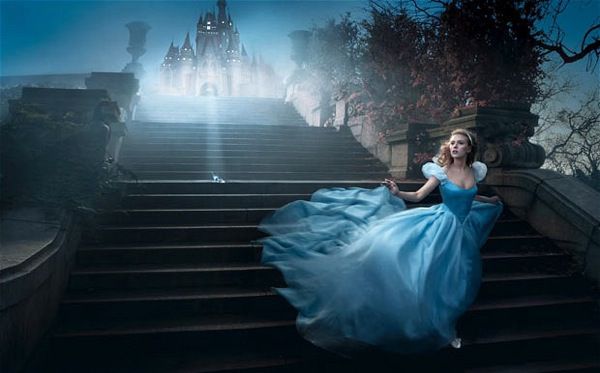
Annie Leibovitz’s new series for Disney. Prescient.
Someone dropped the A-bomb.
Moments after I posted a quote by Alberto Korda, a friend made a humbling comment, he said and I quote: “Your photographs are great, your camera must be that of the high-end ones.”
“Yes.” I said without hesitation, even when I noticed the absence of sarcasm in his question.
Before you judge him, or me, think for a minute about this overstated sentiment.
To them, it’s an honest remark, as much as it is an honest man saying: “it’s easy to act, everyone can play The Black Swan or The King’s Speech, and win the Oscar like Natalie Portman or Colin Firth.”
To most of us it’ll be like: “Yeah, right.”
It’s innocence on one end, pretence on another; both aren’t wrong and neither is right, they’re just there to make up the space for an argument.
Once upon a time, this story happened.
…
Moving in to a new neighborhood, a young couple decides to host a dinner party. The wife, who loves cooking and is good at it, decides to cook and surprise their neighbors. The dinner was a hit. Everybody loved the delicious dishes and the couple love their company, until a beautiful, young lady approached the host and had a little chat.
“It was such a delicious food! Do you mind telling me who’s the caterer?” asked the attractive young woman.
“Sure, me.” answered the lady host.
“Really?”
“Yes, really. I’ve always loved cooking, and I thought I could use some exercise at the kitchen.”
“You gotta show me your kitchen then, you must have some great stuffs in there, … I might have bought the wrong ones, cause my food never tastes so great.”
“What kind of knife do you use? What about the pan? The oven?”
… and the night goes on.
At the end of the evening, the two hosts were standing at the door, seeing the guests off when their teenage daughter joined them. Upon seeing that attractive lady, she made a candid remark.
“Oh my god, you look so pretty… What lipstick did you wear? Your skin, it’s so smooth, I must have bought the wrong soap!”
…
No, the story I heard wasn’t quiet like that, it was similar, albeit a little less dramatic, more harsh and less funny. I was laughing when I heard it but not so much after I gave it a little more thought.
How big of a ‘thing’ can make you a better ‘something’? Would you write better if you have used Hemmingway’s pen? Would you paint better if you have Da Vinci’s brush?
I doubt it.
But, would Harry Potter defeats Voldemort if he uses a different wand?
…
Tools are as useless as they are magical. Even a pen can kill in the hands of a killer, and a sword can mean a thousand poem with a rightful poet. But their impact is undoubted. There won’t be a poem without the sword, nor there would be a story without the pen.
You can say that Hemmingway can write as good, or Da Vinci can paint as beautiful with any other pen or brush, but the fact remains that they too, have their own magic wand that they keep at bay to let the juice flow. There’s always a little something that brings a subtle quality to them, allowing them to create, extending one’s vision from the realms of their mind to the empty space in front of them.
You could take a picture with any camera, have them published somewhere and make my jaw drop, maybe I could do that too, but I would not have felt it coming when I don’t have the vision. And more often than not, such vision comes when I’m natural. I’m natural when I’m confident, I’m natural when my hands are on the right grip. But I’m most natural and confident when I have my blinds pulled the moment I peek through the viewfinder; I hold my breath when I push the shutter button and hear the sound of that neverending click. I become the camera, and the camera becomes my fifth limb. It is joy, eternity and divine.
You could argue that I’m just being a dumb ass, and I could argue that you’re missing out, but my tools are my soul, we are inseparable.
Perhaps I could just jump off the ship and swim away? I once had to operate with someone’s gear during a photoshoot, It happened, and I did great with it. But was it as joyful? As timeless? As divine as my own? Ask a chef about his knives and you’ll know my answer.
This is not a right or wrong argument, people, heck it’s not even an argument. This is matter of personal taste, a choice. Tools do matter, albeit in a smallest, subtlest manner. But, and this is BIG but, when we make a leap out of our comfort zone, and the universe puts us in an extreme situation and we surrender to it: This is when we human beings thrive. See the magic unfolds, witness ourselves make something out of nothing, performing divinity in our own rights.
Some of my best work happened in a split second[1. Based on personal satisfaction.], using an ordinary tool at hand, exactly at those moments; time stopped and I could see what was coming, reality as I know it ceased to a halt during those split seconds, I was the captain, I was the ship, and I was the ocean at the same time.
Fire catches fire, excellence inspires excellence. Any tools crafted by humans were made out of countless choices, those carefully made decisions shape the tool as a finished product, giving each and everyone of them a character of some sort. Each of us see and relate to that differently, we will always know which one is for us when we see it; just like the choices the engineers made to produce the tool.
As long as the sun rises from the East, there will always be a Canon, a Nikon or a Leica. But a magic wand would not cast a spell of its own, neither would a camera take a picture without a photographer. There’s no perfect tool for everyone.
If a wand ever finds its way to its rightful owner, we shall see magic, but once we cross the tool barrier, and learn the art of a wandless spell, the wand becomes irrelevant, thus magic we become.
Abracadabra.
