Branching Sideway

If you keenly observe the movement in the camera industry, you would notice a pattern.

Big-name camera makers typically have three types of product families: consumer, prosumer and professional. Each of the family lineage are usually identified with numbering patterns, for the prosumer and professional products, camera makers often stick to primary, single digits, case in point: Leica, Nikon and Canon.

Leica’s M uses a single digit number up until the M9 (the M10 is the first model since its christening to not use a number). Nikon methodically adapts Leica’s naming format with their F, and now D series professional SLR cameras, the D1 was its first model, and the D6 would be tomorrow’s model if they don’t follow Leica’s path like they did decades ago.

But Canon hasn’t been so religious with their product naming.

Canon’s high-end professional camera model has been, and will always be the Canon EOS 1. The original EOS 1 was a film camera, and every subsequent new models retain the “1” suffix with countless derrivetives: 1N, 1N RS, 1v, and later their first all-digital EOS DCS 1 (the short-lived Digital Camera System join-opt with Kodak), EOS 1D, 1D Mark II, 1D Mark II N, 1D Mark III, 1D Mark IV, noticed the pattern?

Nope. You missed the 1Ds, their first full-frame professional Digital SLR. 1Ds Mark II, 1Ds Mark III, 1Ds Mark…, oops, 1DX, and 1DC. Exactly. Canon is a loose canon when it comes to naming their cameras. Don’t even start with their consumer pockets, it’s a mess. A god-damned mess.

They recently jumped from G12 to G15 after missing G8, jumping from G7 to G9 not so long ago, also, they introduced the G1X earlier this year. What happened with that?

Up in the alley, they have this not-so-consumery, ‘budget’ professional series SLR, not one, but two lineages, the single-digit EOS 5, EOS 3 & its digital sibblings, then there’s the two-digit prosumer models.

I’d love to be in the meeting where they decide these naming schemes. It sounds like they’re fooling us with their jokes the same way we play God in the growing list of [God Games](http://www.macworld.com/appguide/browse.html?collection=7866). Less is more applies to Canon’s numerical product nomenclature (pun intended there, get it?), those closer to 1 is better, newer.

Or not.

When the rumors hit that they’re working on the mythical EOS 3D — the digital iteration of one of the best camera ever made by Canon, the EOS 3 — people were surprised when the 7D came out. On paper they don’t look better than the 5D, but in real, they are a much better-designed camera than any previous prosumer DSLR models Canon ever built. Nearly all of the quirks of early non-pro Canon EOSes were squashed; better shutter, focusing screen overlay, 100% viewfinder coverage, more logical button layout: all checked. But the thing is that the 7D features a pop-up built-in flash that previously only the two-digit EOS bare (the D30, 10D, 20D, 30D, 40D, 50D and 60D all carries a pop-up distraction light).

The 7D was a breakthrough for Canon in many ways, and I suspected then that future Canon EOS will carries this same new DNA, but the 6D has proven me wrong:

> One of the big attractions of full frame SLRs is the viewfinder, and the EOS 6D offers the kind of large, bright view that will come as a revelation to photographers who’ve previously only shot with APS-C cameras. Its magnification is ~0.7x, similar to other full frame Canons, and while the coverage is ‘only’ 97%, this tends to be more of a theoretical than practical disadvantage in real-world use.

> Unlike recent high-end Canons like the EOS 7D, 5D Mark III and 1D X, the 6D doesn’t use an LCD overlay on the focusing screen to show gridlines etc. Instead it offers interchangeable focusing screens, using the same type as the EOS 5D Mark II. On offer are the Eg-D grid screen, or the Eg-S screen that’s designed for more-precise manual focus with fast lenses.

The 6D introduces new button/camera layout, the on/off switch is moved to the top by the dial, and the depth of field preview button is moved to the right direction with significant improvement. But beyond that, it has built-in Wi-fi and GPS, and no words on whether it has the remote flash trigger like the 7D.

So this is a loose some, win some situation, you gain the full-frame awesomeoness, but will miss the 100% frame coverage other Canon full-framers & the 7D offer. You loose all the weight with the smaller dimension, and you gain it all back replacing those EF-S lenses with pricier L optics.

This, to me, is like the imminent arrival of the [much-rumored smaller iPad](http://www.bolopad.com/html/show-22-1510-1.html). Instead of following a recent ‘pattern’ it branches out to a new sea of possibilities & unpredictability. It may not be ideal, and it won’t be a happy news to many, but nonetheless it’s a much more interesting path to grow into.

So maybe you don’t notice the pattern at all, or you don’t need to. And it’s fine. Perfectly fine.

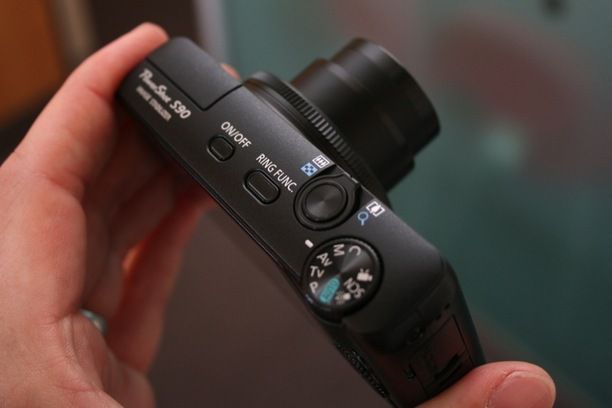
Resurrection of an old compact: Canon PowerShot S90

The good old PowerShot S90.

Amidst the hype of smaller fashionable cameras & useless innovations, some little gems actually came out that are worthy of small-time admiration.

Except for being relatively small so we can carry them everywhere all the time, small cameras are a blessing & a curse rolled into one. What was once the pundits of street photography, is now a carry-on gems of Britney Spears & Paris Hiltons alike, the cigarette pack sized picture taking device has become and indispensable toy of modern urbanites.

I used to argue that manual focus cameras are going to disappear, now I know how wrong & narrow-minded I was with such a blunt claim; after spending sometime with auto-focus high end DSLRs, speeding cars & classic giants, I can now put to rest my fight against old-school legends and embrace their existence as part of the drive for the future of imaging technology & camera development. I also argued not so long ago that innovation has dried out, camera-makers has lost their touch with reality and started introducing features in their distorted reality (projecting cameras, talking printers, smile-detecting camera that doesn’t always work)

As much as I love my Canon (or my friend’s Nikons), I can always find a thing or two that falters my compassion about them, and as someone famous once sang it: ‘You can’t always get what you want’.

Just last week, Canon introduced a few high-end compacts to replace their retiring champs: Canon G11, and Canon S90. After the Ricoh GRD II/III, Olympus E-P1, they are—to my opinion—are their closest contenders of being relatively small enough yet capable of taking good pictures. I’m going to leave the Canon G11 alone, since we are talking about cameras that are small and capable; and I have had my share of thoughts about the Ricoh GRD III & Olympus E-P1, so let’s have a look on the new PowerShot S90 from Canon.

canon-powershot-s90-camera-gallery-10.jpg
Click image to jump to pocket-lint gallery

What’s cool:

  • Look at that design, it’s black, it’s tiny & it’s so neat it’s almost Apple.
  • 28-105 equivalent optical zoom lens—you can snap that hot-looking boys & girls in the mall without being noticed.
  • At f2.0 on its wide end, along with its Low Light mode you can finally take a usable group shot with your hands from the dance floor, the Dual Anti-Noise system should help busting that broken grainy looks into silky smooth picture.
  • The Optical IS (Image Stabilizer) used in its far end of 105mm @f4.9 means you still can snap that hot-looking boys & girls up close without that double vision of blur.
  • 28-105 means awkward motor movement, but behold: lens control ring—finally I can tell my dad to retire his Rolleiflex for good.
  • The control ring is a smart customizable control (blessing or curse?), not only it does zoom, but with the click of a button you can switch to jump between popular focal lengths (28, 35, 50, 85 and 105mm equivalent), shutter-speed, aperture, exposure compensation, ISO and more controls (needs further assessment).
  • The not-so-big sensor is actually a low-light marvel, this time they decided to focus on sensitivity rather than megapixel count. (Finally!)
  • Finally someone figured out how to design a cool-looking camera case that we will use. (see inset below)
  • Full manual control with RAW output!

What’s not cool:

  • No hot-shoe to attach any external flash or remote triggering device. Built-in flash (though it pops up straight) signals: ‘My sensor’s still not good enough, use flash to illuminate dark scenes.’
  • SD card only storage, no CF slot to accommodate the big brothers
  • Ring function button is utterly similar to the on/off switch, let’s hope we won’t accidentally turn off the camera after 1, 2, 3.
  • Video capture limited to 640 x 480 pixels, our HD capable flat screen TV is officially useless.
  • It will cost more than $400 when it hits the shelves next month, you can get a pretty decent DSLR kit with that kind of money.

The best camera is the one with you. The truth is neither mobile phone cameras nor the smallest DSLR will go everywhere with us, it’s either too big or not good enough. This one, however, is actually the one camera that I would take wherever I go, whenever I want it, without feeling lazy. I grow accustomed of pampering my shoulders in my personal time that even a slight hint of weight would throw my mood off the chart.

The fact is, room for innovation is getting smaller and smaller now, besides cosmetic improvements, better sensors and better image quality, we won’t see much a space-rocket invention any time soon, the time has come now where photography has become an industry rather than art, where profitability triumphs beauty. So if you’re on the market for a new camera, you might wanna check this one out.


update:

A note about the Low Light scene mode, this new camera comes equipped with a 10.0 Megapixel *CCD* sensor, I’d assume it would be CMOS, and I was wrong. Canon’s current DSLR lines, as well as some recently introduced High-end digicams have been produced with CMOS as their image capturing centerpiece, this is a definitely a surprising move from Canon:

The PowerShot S90 employs a newly-developed, 10.0 Megapixel High Sensitivity System by combining a powerful CCD sensor and Canon’s DIGIC 4 Image Processor. Thanks to this technological advancement, the S90 is dramatically more sensitive than cameras with identical megapixel counts, and delivers spectacular images with minimal noise. Increased sensitivity demands a higher ISO speed, and the PowerShot S90 delivers with a new maximum setting of ISO 3200. Blur and camera shake are notably reduced for the ultimate in sharpness and clarity.
In addition, a new Low Light mode lets you capture images in an astonishing range of conditions. The camera automatically adjusts the ISO speed from ISO 320 to ISO 12800 in relation to ambient brightness, subject movement and camera shake.

Jump to PowerShot S90 Official Homepage for some sample shots & more details.

Further reading:

The Canon S90: Old Champions Brought Out of Retirement (The Online Photographer)
Canon PowerShot S90 hands-on (dpreview.com)
Canon PowerShot S90 Gallery (pocket-lint.com)
Canon PowerShot S90 Specification (dpreview.com)

Overexposed: The Blurry Picture of The Imaging Industry

Have we forgot that we invent things? Here’s a picture from Maira Kalman:

Recently Leica came up with a new camera system, Nikon introduced a slew of new products last weekend, while Kodak seemed to have jumped at the video market and came up with a Mac-friendly, 1080p HD pocket camera along with some point-and-shoot cameras.

Yet, some not-so-distant 4 decades ago people took a shot at the moon and landed there.

Are you seeing the pattern—or more appropriately—the gap, here?

No real invention has been made to the league of extraordinary light-capturing, image-making world where some Japanese, aptly named Canon, Nikon, Olympus, Sony, Konica/Minolta have conquered this playground a few decades ago and took the game over from the Europeans of Heir Leitz, Sir Hasselblad, Mr. Carl Zeiss. Recently Jim of the United States of America claimed that he has found a future-proof formula to the still/moving camera-making world with his RED Digital Cinema Camera Company, and its modular-designed camcorder/DSLR hybrid.

Nonetheless, we are very excited about this recent development, Leica S2 expected to make a jolt only to drop the bombshell and announce its jaw-dropping price point for the new system, and RED is still yet to conceive a universally accepted software solution for both the video and the photo images it captured. You see, videos & photos are two different worlds.

So where do they left us?

The very notion of photography (image capturing craft) as an expensive and not-so-easy hobby have left a considerably comfortable playing field for them camera makers, unlike the computer/software industry where people now lives & breathes by it, they can make mistakes and go away with it in glory, they don’t have the sets of eyes & ears of the awry bloggers & journalists of the world wide web where they spotted some irregularities like Apple’s rejection of Google Voice iPhone App from their App Store, made some buzz, and days later Obama’s crew picked it up and made formal inquiries where some real answers—or even changes, are expected to come fold.

We, photographers, on the other hand are left cold. We have to survive between the optical crispness of an image and some poor engineering in between, the word ‘usability’ is unknown behind the lenses, let alone ‘notable industrial design’. We’re like the spectators of the megapixel race where there’s no judge nor referee to call the fouls, we’re consumers of highly priced objects where insurance companies do not have products like Auto-mate, or Life-Sure, or Edu-Safe in most part of the world[1. Most developing countries do not offer insurance for photographic equipments.], an industry where there’s no Photographic Products Overseeing Committee or Photographic Usability Commission, we are abused by the vision & persistence we photographers go by, the very thing that produced the photographic industry in the first place.

That was the state of the mobile communication industry, until Apple came to the game.

The iPhone has changed the rule of the game, uplift the whole thing altogether and turn the game into some mature play, they move the industry with real inventions, they put some smiles in a lot of people’s faces. The broken voicemail? Fixed. The unnecessary buttons & clumsy interface? Changed forever. Technology that we can touch? Done. Copy & Paste? Piece of cake! And not to mention how millions of developers joined up the ride and develop 3-rd party Apps, helping the wheel of innovation move faster.

The camera that we came to know now are basically imaging computers, behind those optics & metal enclosures are silicons driven by binary codes, the same codes that empower the computers or mobile phones that we use everyday, only the different thing is computer software has standards. We have software usability groups, hackers & journalists who knows what’s wrong and help protect the users from the oblivion of poor software, want an example? Windows Vista.

Camera software do not have such luxuries. It mainly consists of 3 different layers: 1) a firmware that governs the camera and its functions/features (operating layer), 2) image processing algorithm that reads and translates data from its sensor into a computer readable image format (core layer) and 3) imaging software/drivers/codecs that runs in our computer to further develop the images into a usable outcome (user layer).

Development on the user layer is almost healthy, camera makers are making available their codecs for free, some even offer documentation of their specification and we have different companies competing and crafting very usable softwares, good and not-so-good apps are being used everyday to make the world looks better.

However, inside the core layer, amongst the lines of codes, there are arrays of safely guarded secrets that aren’t as healthy, a rooting decay existed here which is practically invisible from the rest of us due to the nature of the afore mentioned particulars. Each company made their camera in a certain way that only they have access to the components and created APIs that are known only to their engineers, which means when they decide to put a feature that goes with a corresponding button, only they can decide how and which button goes and what is the outcome of that button push.

There’s an apparent lack of standards that left us ‘stuck’ for a long winding ride.

Here are some examples: Beyond cameras & camcorders, Canon is also a printer manufacturer, so they assimilated a scenario for us to snap & print a photo directly from the camera and decided to create a proprietary button that do just that, and guess what? People don’t use it, a few camera models later they decided to remove the feature and leave the button for some other good use. Under those big bright viewfinder of a Nikon camera, lies the heart of the image called the CCD sensor that Nikon has battled long and hard to make the colors look right. When they finally got the formula right, they switched side and goes with CMOS which leaves many users in doubt[2. CMOS is what Canon has and still used today to power their EOS line DSLR]. Longtime Nikon users will know the pain of producing color-consistent images between each camera models—similarly non-Nikon users also fight the same problem only at a relatively smaller intensities.

One major flaw in camera design that still exists today is what we call shutter-lag time, though mostly appear in consumer-level point-and-shoot camera, the fact that it still exists bothers me a lot. It’s like a car when you hit the break pedal it stops a few seconds late, it’s no longer a botheration but a crime of some sort. Camera makers publishes only the megapixel or how fast the camera starts, but not how slow the shutter responds to your reflexes. Just because operating camera is not a life-threatening activity it doesn’t mean that the camera makers are exempt from the basic law of human logic.

What is wrong about the industry is not knowing about what we want, but simply to recognize what we DO NOT want, camera makers must learn from the tech industry and steal a couple of ideas from the iPhone or the Mac. Wouldn’t it be great if one could tap, pinch or swipe zoom, focus, scroll an image from the tiny LCD at the back? Wouldn’t it be awesome to record interviews and captions on the go directly to the camera? It would be much rewarding even if one could finally trust the camera and shoot picture without ever correcting the colors! It’s funny how some newer consumer cameras has a face/smile detector but most still couldn’t tell color balance[3. Also known as white balance is a system to adjust color temperature] correctly! Try shooting inside a café overseeing a window and see if the camera can capture both scenes correctly.

Photographers are innovating and inventing images every day, but we are also human beings, not because we are uniquely persistence in what we do they can treat us like god, do anything they want and get a way with it; they have to start inventing and make the camera industry stronger, nimbler & healthier by introducing usability, consistency & user-friendliness to their products. It’d be even better if they could stop their ego fight and work together into creating a standard that benefits no other than us as their customers.

Nothing is ever perfect when it comes to beauty, the grass is always greener on the other side, we are just one tiny eco-system of creative workers and tool-makers whose main purpose is to envision beauty and to craft visual art, such practice can only be maintained with supporting habitat of creative-inducing tools, tools that empowers, inspires and aspires. We are now at a crossroad where the two have met, the question is how do we go from here without ever going lost in the coming journey, the engineering genius must now see how far the vision goes, as much as the creative worker’s workaround of engineering limitation and lack of innovation.

The truth is, the race is not going away. New products introduced by Nikon will soon get a respond from Canon, while others will follow, this will happen again next year, and the year after that. The cycle that moves the industry are being driven by market demand & competition, no longer by pure science. Hopefully, someone will make the effort to bring innovation back to that cycle; fresh ideas on the world wide web and how the images came to life will certainly bring new paradigms in the coming year, some new players will emerge and are already doing creative things on the marketing side for their upcoming surprises, one could only hope that they do something right this time.

We need that change.