Instead of assuming that people are dumb, ignorant, and making mistakes, assume they are smart, doing their best, and that you lack context.
Excellence Has No Expiration Date
When you give everything to what you believe in, you work hard, and then harder, until you have got nothing to give, yet still you feel like you haven’t given enough… that’s the beginning of a long and slow road to excellence.
The journey is long, slow, and taxing, to you, to those around you. But the adventure’s well worth the pain.
There’s a saying in Bahasa Indonesia: _Berakit-rakit ke hulu, berenang-renang ke tepian, bersakit-sakit dahulu, bersenang-senang kemudian_, which says pretty much the same thing in every culture and tradition. You may dismiss it, and laugh to those who pursuit this path, but this journey is inevitable to every living soul, mankind or otherwise. It’s inevitable.
Excellence is not the result, but the very DNA we are all ingrained with. Some of us choose to take this responsibility and go down the rabbit hole, some choose the other direction. Some people go and change the world, others choose to refine the way they brew their cup of coffee everyday.
It doesn’t matter what you choose, really, but once you are there people will notice and see it, they can’t ignore excellence, no matter how small the subject of your choice is.
8 February 2013
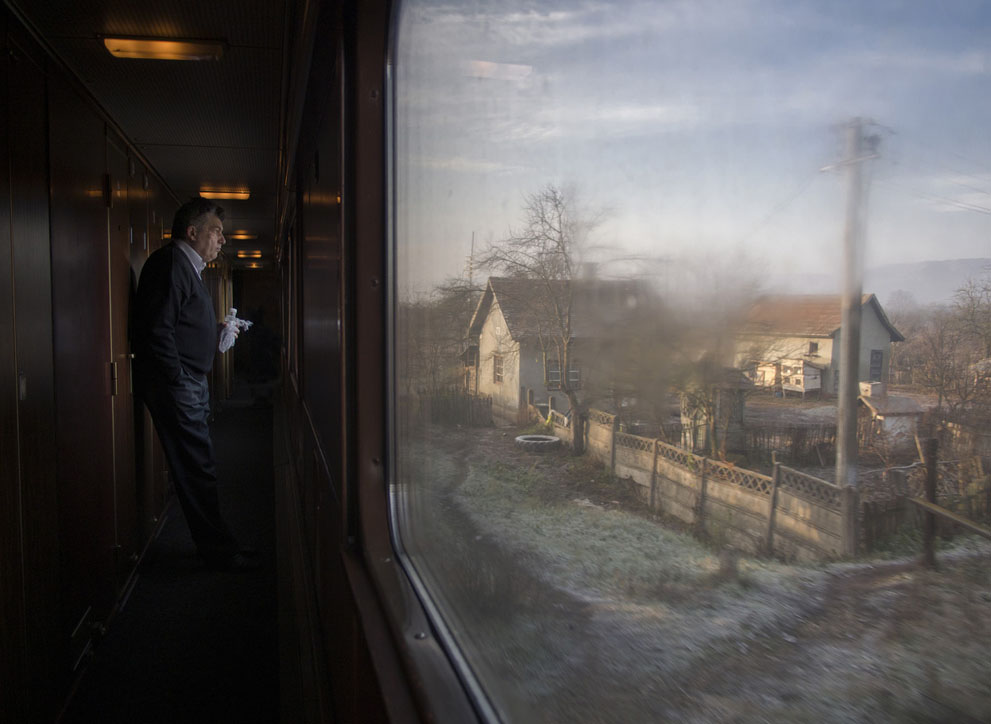 Return to childhood landscapes—the train from Bucharest to Baia Mare in a foggy morning in autumn of 2012. (© Hajdu Tamas, Romania, 2013 Sony World Photography Awards via The Atlantic)
| The World is Our Playground and The Camera is The Window ★ | theatlantic.com |
Return to childhood landscapes—the train from Bucharest to Baia Mare in a foggy morning in autumn of 2012. (© Hajdu Tamas, Romania, 2013 Sony World Photography Awards via The Atlantic)
Sony pulled it off nicely this year, [122.000 entries from 170 countries](http://www.worldphoto.org/about-the-sony-world-photography-awards/):
> In a year that saw over 122,000 entries from 170 countries – the highest number of submissions to date – the judges have selected a shortlist of photographs that stood out beyond all others for their impressive high quality, originality and modern appeal. Topics ranged from haunting shots of the Syrian conflict to the Obama presidential campaign; an intimate study of cinema-goers in Kabul to quirky and witty shots of the animal kingdom.
Simply exquisite, and so much nicer than the politic-heavy competitions such as the World Press Photo.
4 February 2013
| Les Frères Lumière ★ |
Turned out, the [French in Color series I posted earlier last week](/2013/01/the-real-moulin-rouge/) were part of a documentary series funded by [Albert Kahn](http://www.albertkahn.co.uk/),
[who devoted his life and fortune to paying photographic crews to document the cultures of the world with autochromes in an effort to promote peace and understanding](http://www.theatlantic.com/technology/archive/2013/01/well-always-have-early-20th-century-paris-the-webs-renaissance-of-the-autochrome/272713/).
The process, [invented by the Lumière Brothers](http://en.wikipedia.org/wiki/Autochrome_Lumière) were one of the earliest color photographic process whose surviving prints have been digitally restored and [recently exhibited](http://www.nytimes.com/2013/01/04/arts/design/lumiere-autochromes-and-other-early-color-photos.html?pagewanted=all).
31 January 2013
| The Spectacular Thefts of Apollo Robbins ★ | newyorker.com |
“I’m a jazz performer—I have to improvise with what I’m given.”
Not only this is a nicely-written profile about someone who turns pickpocketing into an art form, but also a perfect reminder to working photographers to carry less, and be aware of their gears.
30 January 2013
| The Long Walk ★ | polaroidland.net |
Recently-unearthed video of Dr. Edwin Land introducing the then-new Polaroid manufacturing complex for the shareholders. Like most thing of Land’s, everything looks grand and ahead of its time, even for today’s standards.
Bill Warriner, the director of the film had this to share:
> It hits me now that although he ad libbed it, there’s a stiff, uptight delivery style in front of the camera that he never had on stage. It’s an odd self-consciousness. Onstage in front of 3,000 people he was truly in command; here it seems like the camera was in command. By the time we shot the scene where he made “the iPhone prediction,” the day had worn on and he had loosened up a little. And he became profoundly eloquent during The Walk. He was also, in his favorite word, elegant. […]
> It’s really instructive to revisit Dr. Land’s slow pacing, reflecting down to Mother Earth; it was his signature even on stage. He would sometimes keep an audience breathless through a long silence; the longer it was the more dramatic it became. I sometimes wondered whether or not he understood that–and it was thus an affectation–but now I believe he was truly shaping the words during those pauses. I don’t believe it was stagecraft. He cared about getting the phrasing precise, like you do. He wrote the script in real time, and he did not want to commit to the words before that moment came. The title “CEO” seems very odd because his cadence was not like that of any other CEO ever. But today I thought I would still not cut a single sentence out of the continuity of The Walk, even though 16 minutes is a tough slog for today’s spans of attention.
_Update:_ One thing stuck with me after seeing the entire sixteen minute short: Land’s vision for photography, how he strongly believed that it will be one of human’s evolutionary milestone is amazingly apt, down to the ‘take a camera out of your jacket pocket and snap a picture.’
| Nose Jobs ★ | cultofmac.com |
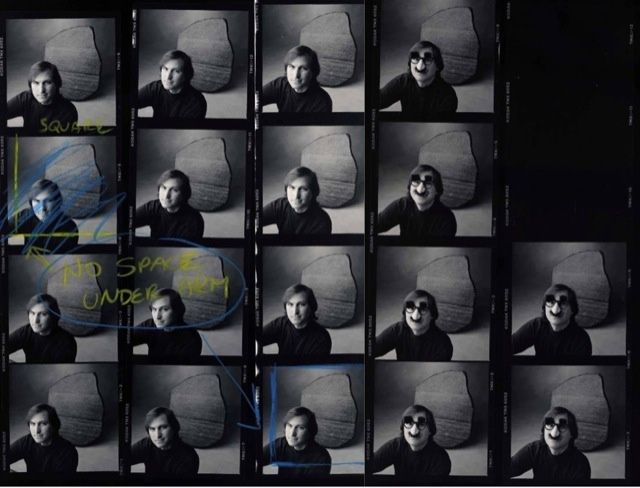 ](http://www.cultofmac.com/212065/nose-jobs-the-story-behind-the-most-incredible-steve-jobs-photo-youve-never-seen-feature/?all=1) © Tom Zimberoff
> Delighted a photograph that had always been a personal favorite had been chosen for the book, Zimberoff chose to email the photo to a small group of friends, who in turn, forwarded it to Jamis MacNiven at Buck’s. MacNiven then remembered his own run-in with Steve Jobs over Groucho glasses, and was so effusive about his appreciation for the photograph that Zimberoff agreed to print a copy of Nose Jobs for display at Buck’s.
I read somewhere that one of the quality of a visionary is unpredictability, and having a great sense of humor.
| ‘Sonikon NikkorNex’ ★ |
Whereas the scientists attempt to store digital data on a DNA speck, this photographer attempts to [put a digital brain onto a vintage analog camera](https://plus.google.com/photos/113804062246503305242/albums/5837844165184674913).
| 739 KB ★ |
Inspired by the resilience of the data stored by the DNA, [British-based scientists were able to store and retrieve a sequence of Binary code — Shakespeare’s sonnets — on a DNA speck](http://www.scmp.com/news/world/article/1135400/british-scientists-use-man-made-dna-speck-store-739kb-digital-data):
> The process involved converting the ones and zeroes of digital information into the four-letter alphabet of DNA code. That code was used to create stands of synthetic DNA. Then machines “read” the DNA molecules and recovered the encoded information perfectly. The reading process took two weeks, but technological advances are driving that time down, said co-author Ewan Birney of the institute.
This is computer and biological engineering at its best, quiet simply, the closest thing to [Johnny Mnemonic ](http://www.imdb.com/title/tt0113481/)I’ve known thus far.
| Reactions ★ |
A different kind of camera app from [George Holtz](http://geohot.com), who was the [internet-famed iPhone hacker](http://en.wikipedia.org/wiki/George_Hotz):
> At Reactions, we offer you no way to save your pictures. If you want to save them, you have to share them. After a reaction is captured, you have 3 seconds to hit the unlabeled cancel button, or else your photo is automatically shared with all your Facebook friends.
As the name suggests, Reactions captures your reaction with the front-facing camera, and the scene, with the back camera. It’ll be fun if we can swap between the larger and smaller frame, so that our face is the main attraction.