The Coming of the Third Kind: Meet the iPad

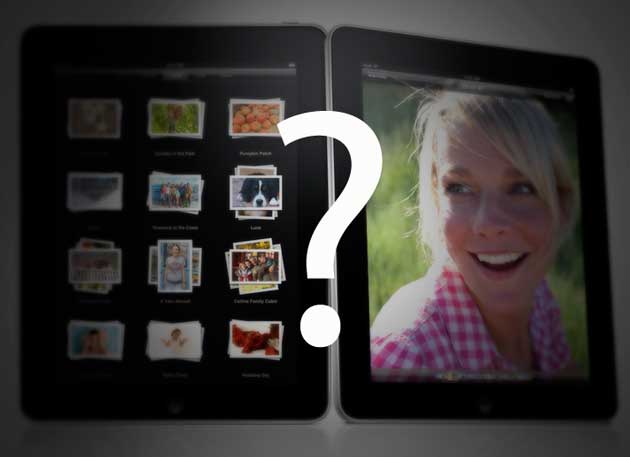
whattheipadcandoforyou.jpg
© Apple

Updated with additional commentary.

Originally titled ‘What the iPad really is, what the iPad may become’

In November 2009, I wrote about a unique app that changes the way people do photography with their iPhone in The Missing App & What Lies Ahead article:

CameraBag might be just the first of a new generation of imaging apps to grace the desktop space; one that does just one thing and delivering it with an uppercut instead of multiple & tiring jabs; the desktop imaging space has been anything but bloated, complicated & overpriced, the arrival of such app will open up some new horizon of what can be done and how to do it simple.

Apple has raised the bar once again, dubbed as the iPad, the tablet form device is their answer to the NetBook. Sporting the now standard accelerometer, compass & multi-touch screen display, the iPad is a giant iPhone utilizing a custom-designed, integrated, mobile-optimized Apple A4 chip running a slightly modified iPhone OS on a 1024-by-768 pixels with 132ppi pixel density.

The big surprise isn’t the long-expected Apple’s own chip, the 10-hr battery nor the gorgeous software UI, it’s the 4:3 aspect ratio that Apple themselves killed with their introduction of widescreen displays, who’d want 4:3?

Adam Lisagor made an interesting observation; while it is technically logical & convenient for Apple or developers, it is uninspiring both creatively and artistically.

Scientists & mathematicians have long argued that 3:2 is the golden rule for universal size ratio, visually amusing & scientifically correct doesn’t mean it’s technically/physically logical, but unlike a laptop or TVs, the iPad is designed to be used vertically, like most magazines & paperbacks.

Regardless of the pixel density or size of the display, the iPad is a digital canvas that gives us a touchable art with its excellent multi-touch gestures/accelerometers & the App Store’s 140.000 and counting app catalog — given our 10 fingers and unlimited imaginations, the iPad is a magic pad that’ll bring our art to life, instantly!

What the iPhone lacks was a screen size that makes sense, what the desktop/MacBook lacks is multi-touch fullscreen displays that limits our live interaction with whatever we are doing, imagine, instead of click and dragging the mouse while fiddling with a never-ending list of keyboard command, we are actually touching, pinching, swiping our subject directly on screen, for the first time ever, we are finally operating on our patients with with real clamps & knives like doctors have been doing all along. Would you trust a surgeon doing it via a keyboard and a mouse?

Like the iPhone, the iPad is unveiling that missing link between us & the digital space, and taking it further for our day-to-day and professional lives. Like the iPhone, it to revolutionize personal computing to the point it makes perfect sense, those of you who think they’re not powerful enough, who think that iPhone needs its own finder to play with the file systems, should really have some moments alone and ask this question: “What is the purpose of all this?”.

The reason how the iPhone has made Apple a $50 billion company, and the reason why millions of people around the world are craving for it, is the same reason why you we all pay a hefty price for a car that actually hurts the environment; there’s a need for it, and all it need is an engine and a set of 4-wheels to make a car; and the iPhone with its gorgeous multitouch screen display, a home-button, on/off & ringer switch with volume control is what it takes to function as a phone, heck, car keys are almost irrelevant these days, and Apple is leading us to that vision where simplicity is a bliss.

Even at such a low price (starting at $500), Apple is going to have a tougher time selling it to the mass, the iPhone, a pocketable computer that actually does make phone calls and the MacBook & the iMac are proven entities of what people need computer-wise; photography, painting or book-reading aren’t as straightforward, down-right-simple as listening to music from your iPod, it takes more than just pushing the play button for people to get used to the iPad, but the potential is definitely there. We just need to grow our imagination, widen our horizon and opening up to the infinite space of possibilities… we need to progress and the iPad has now finally came along for a whole new experience of personal computing.

Photography, as Steve Jobs said during the iPad launch, has never look so beautiful on any device, ever. His vision, along with the brilliant minds at Apple is to close the gap between technology and liberal art — when things are so well-thought, well-planned and finely executed, doesn’t that make it a form of art?

The CameraBag app—being the inspiration of the aforementioned piece—is a good illustration to what the iPad is capable of, and how visual artists and photographers can integrated it as their tool-of-the-trade. There are hundreds of thoughts and ideas circling around the web on what the iPad can really do, specific to photographers, Photojojo posted some ideas on (what I also think) how it can be used by photographers, let alone it’s IPS screen designed to consistently display colors and brightness from any angle, and a little bonus of ‘Photo Frame’ mode (the icon next to the unlock slider)… developers, camera makers, are you imagining yet?

What a great way to start the new decade.

Hello iPad

RIP-Laptop-1980-2010.jpg

And we shall witness the birth of a new era.

The Pluralist

“Saya ingin di kuburan saya ada tulisan ‘Disinilah dikubur seorang pluralis'”

“I want my gravestone to read ‘Here lies the body of a pluralist'”

– Gus Dur (1940-2009), Indonesian President, Pluralist.

Freelensing

Freelensing Samples
© Luke Roberts

All I can say is this makes perfect sense and I wonder why we haven’t come up with this any sooner.

If you are familiar with the LensBabies and bellow-based perspective control, It is Freelensing at its best — the difference with this technique is that there’s no bellow or similar tools involved in moving the lens, this one’s freehanded.

Use with care (don’t drop your expensive glass!) and be creative! Light leaks will happen but it won’t ruin your picture, and there’s no rule whatsoever.

Head over to the freelensing flickr group for examples and head over to Luke Roberts’ Blog here for details & description.

/via @Cocoia

11 January 2010
Forever City

Creating Digital Realism

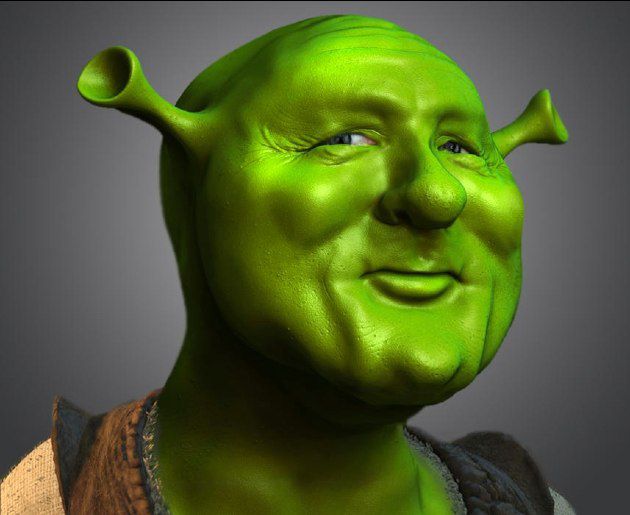
Shrek_Clinton.jpg
Clinton as King Shrek by Alex Ostroy

Beyond the simple yet often complicated world of visual art, lies a complex web of cultural, social, psychological & technical context a photographer should master to be able to capture the realm of persona, an aura of energy, the vision & character of his/her subjects in the time & space that they are being photographed at.

It is that mastery that sets things apart. Mastering it is what makes a photographer, a painter, a musician, a sculptor, a chef, a writer (or any kind profession) an artist, understanding with a touch of appreciation is the Art.

At the same time, what can be an extraordinary work often often gets mixed up with production complications, even the best of the best can barely achieve perfection, some work gone to a better path, many shall flunk while time & money is the two things no one will ever have enough.

That’s where Alex Ostroy came to the picture.

John Goldsen, CGI online:

…with the work being done by Ostroy, extraordinary realism has become a given, what makes the work compelling is the sophisticated understanding of studio photographic lighting technique. he is one to always keep an eye on…

The key to Ostroy’s success is none other than his complete mastery of a technique and intuitive understanding where his client & his vision lies, he becomes that bridge, the interpreter of the force that will guide him to the end of the journey.

It is mesmerizing to see his spectacular art; understand that it is not the technicals, nor his tools that creates the artwork, but his passion & his persistence to break his boundaries each and every time.

Meet Canon’s new sword

Meet-the-sword.jpg
© samurai: Kage-Warrior, lens: Canon.

If a Samurai swears by their swords, a photographer swears by their lenses. Nearly 8 years since the first version was introduced, Canon today announced a new replacement to their legendary white-bodied telephoto pro-grade zoom lens, the Canon EF 70-200 f/2.8L IS II.

What’s so special about this lens that I bother writing about it? Well, trust me, this one’s different.

Focusing distance is to the lens what the shutter delay is to a camera body. One can always wait a little longer, or move aback to get the shot, but we also loose the critical moment. Another way would be to cook some magic in the labs, and let these obscure designers, scientists & engineers move their wands around and create the impossible. And that what Canon has achieve today:

A reduced minimum focusing distance of 1.2 metres (3.9 ft) and improved 0.21x magnification will allow photographers to get closer to subjects without needing to swap lenses – greatly benefitting time-pressured news and events photographers who require flexibility. An updated Image Stabilizer mechanism also offers a shutter speed advantage that’s equivalent to four stops, reducing the effect of image blur resulting from camera shake in busy shooting environments.

What you see as a mere .2m (20cm) closer, is years-of-work of number crunching, glass-polishing, super-high-tech-craze back at the shop, their closest competition, Nikon, released a similar lens last July, and they only manage to cramp 1.4m. Trust me, 20cm can cost you your job on the frontline, imagine you’re shooting the world’s most important person delivering speech in a room full of journalists, that 20cm became your most valuable distant you’d ever hope for when you fail to… ergh, focus! Oh that squeaking sound of failed motor movement!

Changes are good, but what Canon has achieved in the last couple of months are more than good, they’re sensational… big, bright 100% viewfinder coverage on a not-so-high-end camera body? Check. Better sensor that doesn’t involve the buzz-selling megapixel count? Check. A weather-proof camera body that would not break after the rain? Check! Check! Check! Canon is breaking the ice, people. Pay attention, and you’ll thank them later.

Leica, Nikon, Apple and Sony (who helped lowering camera costs & beauty standard), you guys deserve the credits too, I’m happy that finally you can quit fighting like a baby and start competing like a man with your latest toys, keep it boys! Cause we’re going to be at the finish line, waiting for your next sensation to come.

(PS. They even throw in a new lens case that you might finally use)

5 January 2010
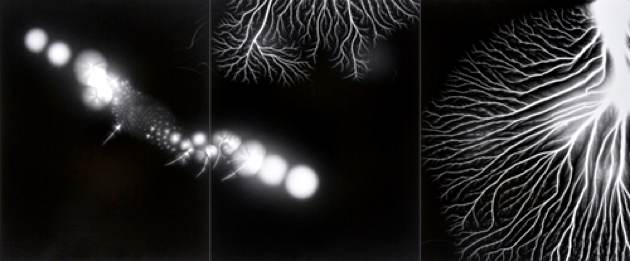
Bending the rule of nature for Art sugimotohiroshi.com