Hocus Focus

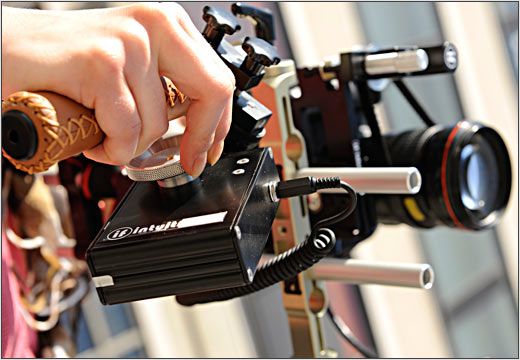
Intuitfocus HF-IF1

Follow focus is to Hollywood, for HD-DSLR is to filmmaking, Intuitfocus HF-IF1 is the 5D of HD-DSLR follow focusing:

The IF system can be used on all DSLR cameras with lenses from 14mm to 600mm, including shooting with Zeiss still or compact prime lenses. The IF system is easy to mount and is compatible with most lenses, and enables one to focus or to zoom precisely and quickly without any camera shake.

This thing about focusing will go away if camera makers solve the root problem. SLR cameras are designed to capture still photograph; our current focusing technology was based on a two-decade auto-focus problem, now that most DSLRs can also be used to shoot videos, a new auto-focus system is needed to solve this new problem.

Abstract: Detecting an object from the viewfinder, instead of snapping to a focused position, the system would identify movements, and from the distance, direction, speed and sets of moving patterns; calculate and predict a focusing point that would be maintained, and/or gradually shifted according to the position of the object and the camera’s film plane. Add to it, the existing image stabilizing technology, super-sensitive image sensor capable of high-ISO & wide dynamic range light capture — filmmaking will never be the same again.

Okay, that sounds like crazy sci-fi sensation, but remember a few decades ago when auto-focus, auto-exposure, hypersonic-wave focusing motor, were nothing but a dream? As many optimists would say, everything is possible as long as we can imagine it.

Postscript: Now that we’re talking sci-fi, has someone devised a non-linear digital image sensor that has “memory”? A sensor that not capture a single linear moment of image, but record a non-linear memory of the light itself? This would result in a truly RAW state so that the photography can be done entirely post-capture — think of a darkroom enlarger but with multiple negative films with infinite combinations of ƒ stops.

It would completely ruin the beauty of photography, but it’s no crime to imagine for a bit, no?

Island of the Spirits by John Stanmeyer

Island of the Spirits_Regular.jpg

update: link to video & behind-the-scenes gallery added.

Bali, the quintessence of a rich spiritual & cultural community is empirically known throughout her history as the land where people come as tourists, but often leaving as artists. Some of the world’s most well known painters, musicians, photographers — artists — have spent time and at some point of their lives, lived on the island. There’s that quality about Bali that attracts souls of any kind.

John Stanmeyer, a member of the VII photo agency spent five years living there, during which, through the lens of his holga, he captured the enchanting life & spirits of the island’s living, breathing & invisible souls, and produced this exciting new title:

Spirits are everywhere in Bali. Trees, temples, mountains, stones, water appear sacred to the Balinese, all serving as a hand reaching out and into the otherworld of ancestors and gods and the maelstrom of good and evil. […] This body of work stresses the historicity of spiritual life of Bali, consisting of deeply layered imagery that is witnessed, understood and explained in full by few, yet practiced by millions.

The book will come in regular & special limited edition (pricing to be announced) and the first edition is currently wrapping up production in Jakarta where an exclusive behind-the-scene gallery has been published, also up is a short video feature on VII Multimedia.

Zeiss Literature zeiss.com
7 August 2010
A love letter from Marian Bantjes ted.com

The Man of His Time

avedon_double_2.jpg
© Richard Avedon

I never realized how much I enjoy Richard Avedon’s work after I revisit my old DVD, Richard Avedon: Darkness and Light. Further reading leads me to this exquisite feature & commentary by curators Carol Squiers and Vince Aletti for the New York Times.

The entire cut is about 6:00 min long, if you’re in a hurry, here are some bits that I found to be awakening.

On feelings:

Avedon was always looking for another way to show how women thought and how women felt, and that meant it they aren’t necessarily always just feeling beautiful, they might be insecure, but they might be also very very happy. Avedon really made the laughing woman a real subject in fashion.

On ‘color’:

There were not supposed to be any people of color in Harper’s Bazaar magazine, for Avedon, people of color were part of the spectrum that were normal natural to him, In his quest for beauties — that were not just your average American beauty — he looked at women who were of different ethnic background, one of the first ones he came up with was China Machado a woman of Portuguese and Chinese ancestry. He actually had to threaten to quit Harper’s Bazaar in order to get them to use China Machado in the pages of the magazine. This particular fight only escalated when he decided he wanted to use a black model whose name is Donyale Luna.

On being true to his vision:

Avedon always seem to be slightly ahead of his time in terms of whatever the social and cultural thinking was of the time. He always seemed to be pushing pushing the envelope and getting himself into trouble but because he was who he was, he could threaten and they would bend to his will.

More about his vision, Vince Aletti added:

I think what he did best was compress the movement that he had on the street, the kind of attitude of excitement and exuberance that he captured with models out in the world was able to put that into the studio and capture that for the page. […] Avedon was always very much a person of his time, so he was really attuned to the energy and exuberance of the 60s, and the radicalism that was there as well and wanted to kind of translate that into the work as well, if only by encouraging his models to let go, to really spread across the page, or to really be excited and convey that sense of excitement out to the world.

What I noticed in the last couple of years is that fashion pages on the magazines today no longer has so much weight in its content — weak concepts, repetitive looks and most destructive — albeit the most unapparent — is the personification of the fashion, and the objectification of the person behind it. Feelings & expressions are kept at the bare minimum — making them almost irrelevant at times, and at the same time turning the fashion products into biblical objects.

Perhaps this is one of those period in history books where we are at the turning point where consumerism is the new world order (or religion, on this matter). One can only hope that this is just — well — fashion at its best.