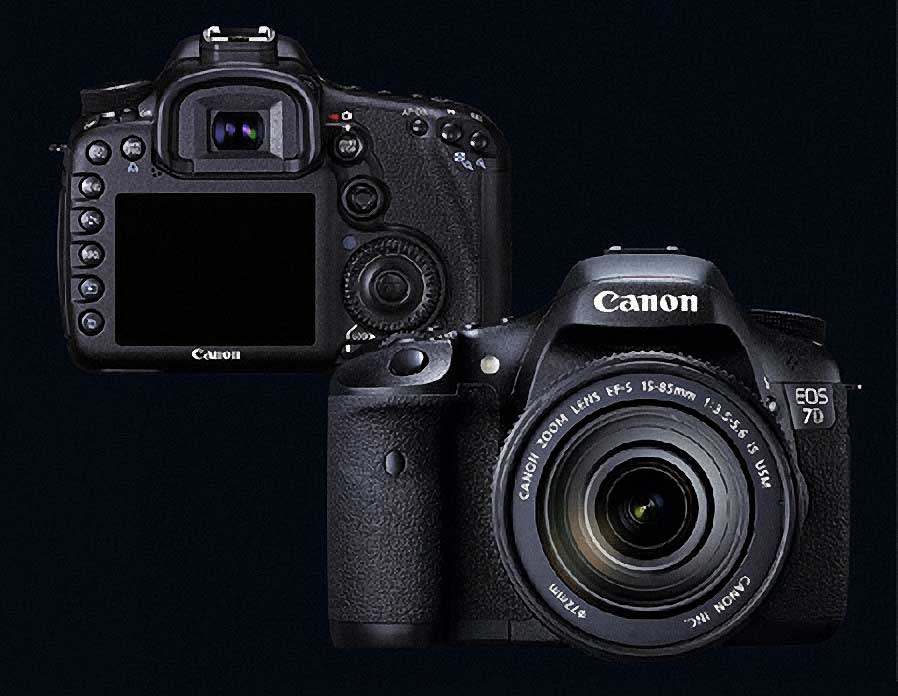
Rumor has been going on for months, but new materials have surfaced and are too elaborate to be fake. With some of my long time cry hopefully to be answered, if all are accurate, this will be one of that turnover moment people are eagerly waiting for.
All-new iFCL intelligent metering system (calculates highlight & color)
3.0″, 920K dots, 160 degrees of viewing angle with anti-glare High Resolution LCD display type II
Full HD capability, external stereo mic input & HDMI output
Live View with Face Priority AF
New Video/Live View button switch
Aero Dynamic Body Design, metal characteristic shutter sound up to 150.000 cycle
All-new 24mm built-in flash with EOS Intelligent Speedlite System (finally!!!!)
Highlight Priority Mode
Lens Vignette Control
More Picture Style
EOS Integrated Dust Reduction System
update:
It’s a deal-breaker for some (myself included) to put another cropped sensor in otherwise an excellent machine; which would also suggest that the 7D will be just a prelude to more exciting cameras to come (5D Mark III? 3D?).
What will be the most surprising upgrade is the 100%, 1.0x viewfinder, for years, Canon only introduced this important feature to its 1-series cameras, and finally, what Nikon has put for years in most of their DSLR camera will finally emerge in Canon: Electronic viewfinder display assist.
On the other hand, what Canon introduced in the 90s which has become a standard feature today, Image Stabilization, finally saw the light of another innovation from the big brother (Canon invented the Optical IS). Rumored as the Hybrid IS, it is supposed to tackle a different kind of potential image blurring, I have no technical details for now except to say as much.
Finally, what photographers has been crying over the years, what Nikon has fought and won users, built-in wireless flash triggering system will finally be introduced in this supposedly new camera. Good bye ST-E2, Hello 7D!
Also expected is the new 100mm f/2.8L Macro with IS, I cannot guarantee the accuracy of this release, but let’s hope Canon did come to their senses and start producing real DSLR upgrades in the future.
We have no confirmed release date or the price for this camera, let’s first see if the 7D is coming at all and find out what the fuss is all about.
The key is not being afraid to make mistakes, but to feel safe making it and quickly move on—we all know that, but what we forget most of the time is to *know* when we make such mistakes and how to fix it. Apple has Steve Jobs, and Disney Pixar has John Lasseter. What about you?
Toy Story 3 director Lee Unkrich:
The project “wasn’t working at all,” he says, until Lasseter stepped in at the 11th hour, tore up what was there and rebuilt the story to resonate with audiences, pulling off what many at the studio consider Pixar’s best film. (And that was hardly an isolated case. “Ratatouille” was repaired much the same way, with “Incredibles” director Brad Bird overhauling the project late in the game. Lasseter even allowed director Andrew Stanton to “reshoot” a couple scenes on “Wall-E” — a costly fix rare in animation.)
Surprising history was made when one of the world’s leading camera company introduces one of the ugliest & cheapest full-frame DSLR. A company was purchased by its rival and again purchased by another rival to fight the other two biggest rivals to try to out sell one another. Today the Minolta-Konica-Sony’s latest incarnation—Sony A850 was introduced and won two of the world’s most prestigious contest in the world of DSLR, nominees are:
update: see below for the link real ugly looking cameras archive.
2009 nominees for the lowest-priced, Full-frame DSLR:
Sony A900
Canon EOS 5D (Mark I)
Sony A850
2009 nominees for the world’s ugliest DSLR:
Sony A850
Sony A850
Sony A850
…and the winner for 2009, cheapest & ugliest DSLR are:
I have given up TVs and Newspapers as my source of news. For a simple reason non other than the nonsense & soul-killing nature of how, meaningless events are turned into some dollar making piece of junk. But I love movies.
Movies, on the other hand, are the opposite of headline news.
Regardless of how untrue a movie is, or how dramatic it is turned out, it is still a movie, a collective work of wisdom of some of the brightest mind & talent that is entertaining, sometimes rewarding and inspiring, but the beauty lies in the bucket of choice it entails, whether to watch it, or to ditch it, believe it or ignore it. Not surprisingly, it is often more true than any news channel or print media can present. The sentiment is, if it’s on the news it is true (I choose not to believe so) it will still be regarded as fact regardless of the truth, this ain’t pretty choice at all.
The world is not perfect.
The Internet, as history suggests is still in the dawn of its age, it is young, raw & barbaric, it is the world’s biggest catalog of truths & lies, it is also home to the world’s largest cage of copycats.
Don’t believe me? Here’s an example:
This is an excerpt of an article from a blog of one of Indonesia’s largest and oldest print magazine TEMPO, the article is in Indonesian and here’s an excerpt:
Taobao.com adalah fenomena. Ada jutaan orang yang membuka toko daring di sana, dari mahasiswa, pensiunan, sampai ibu-ibu yang bosan menonton opera sabun. Ledakan pengguna Taobao.com bahkan mengalahkan eBay.com — situs lelang dari Amerika yang sempat ekspansi ke Cina.
Internet analysts say this booming marketplace — reminiscent of the early days of eBay, when Americans started emptying their attics for online auctions — has turned Taobao into China’s newest Internet darling.
So what’s the story here? Deadline? Slow news day? Trying to think outside-the-box? What about look deeper inside and have some heart? Recently, our dear neighbor Malaysia has been busy claiming our national heritage as their own, and our government has been busy doing some work of diplomacy of defending our nation’s pride, so let’s not ruin their effort and divert the attention to some cheap plagiarism, if you want to copy, go copy the efforts, not the result, go grande!
Yes, it’s not illegal to quote from other’s piece, but it is not ethical when the writer did not link back to the original source, yes, this Tempo blogger seems to have done his own research and added some locally relevant data to make the piece relevant, but I’m not too sure if this is right at all.
Amidst the hype of smaller fashionable cameras & useless innovations, some little gems actually came out that are worthy of small-time admiration.
Except for being relatively small so we can carry them everywhere all the time, small cameras are a blessing & a curse rolled into one. What was once the pundits of street photography, is now a carry-on gems of Britney Spears & Paris Hiltons alike, the cigarette pack sized picture taking device has become and indispensable toy of modern urbanites.
I used to argue that manual focus cameras are going to disappear, now I know how wrong & narrow-minded I was with such a blunt claim; after spending sometime with auto-focus high end DSLRs, speeding cars & classic giants, I can now put to rest my fight against old-school legends and embrace their existence as part of the drive for the future of imaging technology & camera development. I also argued not so long ago that innovation has dried out, camera-makers has lost their touch with reality and started introducing features in their distorted reality (projecting cameras, talking printers, smile-detecting camera that doesn’t always work)
As much as I love my Canon (or my friend’s Nikons), I can always find a thing or two that falters my compassion about them, and as someone famous once sang it: ‘You can’t always get what you want’.
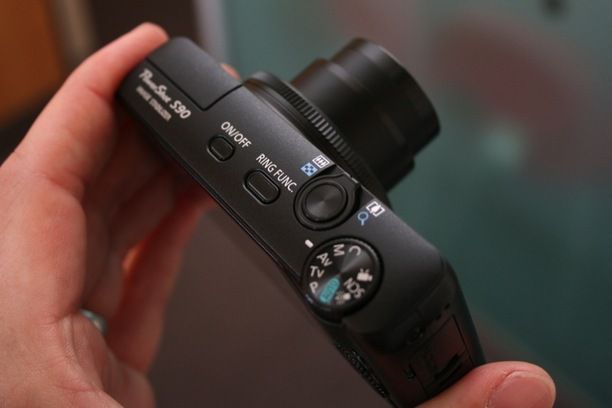
Just last week, Canon introduced a few high-end compacts to replace their retiring champs: Canon G11, and Canon S90. After the Ricoh GRD II/III, Olympus E-P1, they are—to my opinion—are their closest contenders of being relatively small enough yet capable of taking good pictures. I’m going to leave the Canon G11 alone, since we are talking about cameras that are small and capable; and I have had my share of thoughts about the Ricoh GRD III & Olympus E-P1, so let’s have a look on the new PowerShot S90 from Canon.
Look at that design, it’s black, it’s tiny & it’s so neat it’s almost Apple.
28-105 equivalent optical zoom lens—you can snap that hot-looking boys & girls in the mall without being noticed.
At f2.0 on its wide end, along with its Low Light mode you can finally take a usable group shot with your hands from the dance floor, the Dual Anti-Noise system should help busting that broken grainy looks into silky smooth picture.
The Optical IS (Image Stabilizer) used in its far end of 105mm @f4.9 means you still can snap that hot-looking boys & girls up close without that double vision of blur.
28-105 means awkward motor movement, but behold: lens control ring—finally I can tell my dad to retire his Rolleiflex for good.
The control ring is a smart customizable control (blessing or curse?), not only it does zoom, but with the click of a button you can switch to jump between popular focal lengths (28, 35, 50, 85 and 105mm equivalent), shutter-speed, aperture, exposure compensation, ISO and more controls (needs further assessment).
The not-so-big sensor is actually a low-light marvel, this time they decided to focus on sensitivity rather than megapixel count. (Finally!)
Finally someone figured out how to design a cool-looking camera case that we will use. (see inset below)
Full manual control with RAW output!
What’s not cool:
No hot-shoe to attach any external flash or remote triggering device. Built-in flash (though it pops up straight) signals: ‘My sensor’s still not good enough, use flash to illuminate dark scenes.’
SD card only storage, no CF slot to accommodate the big brothers
Ring function button is utterly similar to the on/off switch, let’s hope we won’t accidentally turn off the camera after 1, 2, 3.
Video capture limited to 640 x 480 pixels, our HD capable flat screen TV is officially useless.
It will cost more than $400 when it hits the shelves next month, you can get a pretty decent DSLR kit with that kind of money.
The best camera is the one with you. The truth is neither mobile phone cameras nor the smallest DSLR will go everywhere with us, it’s either too big or not good enough. This one, however, is actually the one camera that I would take wherever I go, whenever I want it, without feeling lazy. I grow accustomed of pampering my shoulders in my personal time that even a slight hint of weight would throw my mood off the chart.
The fact is, room for innovation is getting smaller and smaller now, besides cosmetic improvements, better sensors and better image quality, we won’t see much a space-rocket invention any time soon, the time has come now where photography has become an industry rather than art, where profitability triumphs beauty. So if you’re on the market for a new camera, you might wanna check this one out.
— update:
A note about the Low Light scene mode, this new camera comes equipped with a 10.0 Megapixel *CCD* sensor, I’d assume it would be CMOS, and I was wrong. Canon’s current DSLR lines, as well as some recently introduced High-end digicams have been produced with CMOS as their image capturing centerpiece, this is a definitely a surprising move from Canon:
The PowerShot S90 employs a newly-developed, 10.0 Megapixel High Sensitivity System by combining a powerful CCD sensor and Canon’s DIGIC 4 Image Processor. Thanks to this technological advancement, the S90 is dramatically more sensitive than cameras with identical megapixel counts, and delivers spectacular images with minimal noise. Increased sensitivity demands a higher ISO speed, and the PowerShot S90 delivers with a new maximum setting of ISO 3200. Blur and camera shake are notably reduced for the ultimate in sharpness and clarity. In addition, a new Low Light mode lets you capture images in an astonishing range of conditions. The camera automatically adjusts the ISO speed from ISO 320 to ISO 12800 in relation to ambient brightness, subject movement and camera shake.
Extensive CGI reconstruction of the iconic landmark now allows new possibilities for photographers and other creatives to use the space without restriction or compromise on photo realistic quality whilst preserving the pristine design, and stylish atmosphere that would have otherwise been lost for future generations.
I’ve always debated about CGI’s threat to creativity, both personally and socially due to its inside-the-box nature; it doesn’t have any room for natural incidents nor organic process. Some of the world’s best pictures, my own work included; were born out of small incidents and mishaps that happened during a photo-shoot, or simply a glimpse of idea that appeared during one’s interaction with others on-location. Virtual reality solutions are sterile and tend to halt any process that might spiced up the end result after the lights are turned off.
This however is a fine example of where CGI can be useful: damage recovery. Organic factors aside, many commercial powerhouse will find this relieving, a fresh cup of coffee to any retoucher’s nightmare. Though it requires a certain level of digital mastery & perspective pre-visualizing, the end results can be both daring & disastrous, one thing is sure though; it ain’t gonna be cheap.
The first step is masking out objects in the scene so that we can turn those objects 3-D,” says IMAX’s Eric Robinson as he shows off the software. “The next step is, re-create the scene in 3-D so that we can generate depth information from that. Our proprietary render system generates a new image, which is offset from the original.
P.S. The rest of the clip is all marketing cr*p, skip after 01:00. See the clip here